

Categories
Local Market InsightsPublished October 12, 2026
Attleboro Housing Market Update: More Homes, Higher Rates & What to Expect in 2027


The Attleboro housing market is changing. And I think both buyers and sellers need to understand what's happening before making their next move.
Mortgage rates remain elevated. Buyers have more homes to choose from. Properties are taking longer to sell. And some sellers are discovering that the negotiating power they enjoyed over the past several years isn't quite what it used to be.
But here's what's interesting: Home prices haven't collapsed. In fact, the average sale price in Attleboro is still higher than last year.
So are we heading toward a buyer's market? Will home values decline? And what should we expect as we enter 2027?
Let's look at the numbers, what I'm seeing firsthand, and what could be ahead.
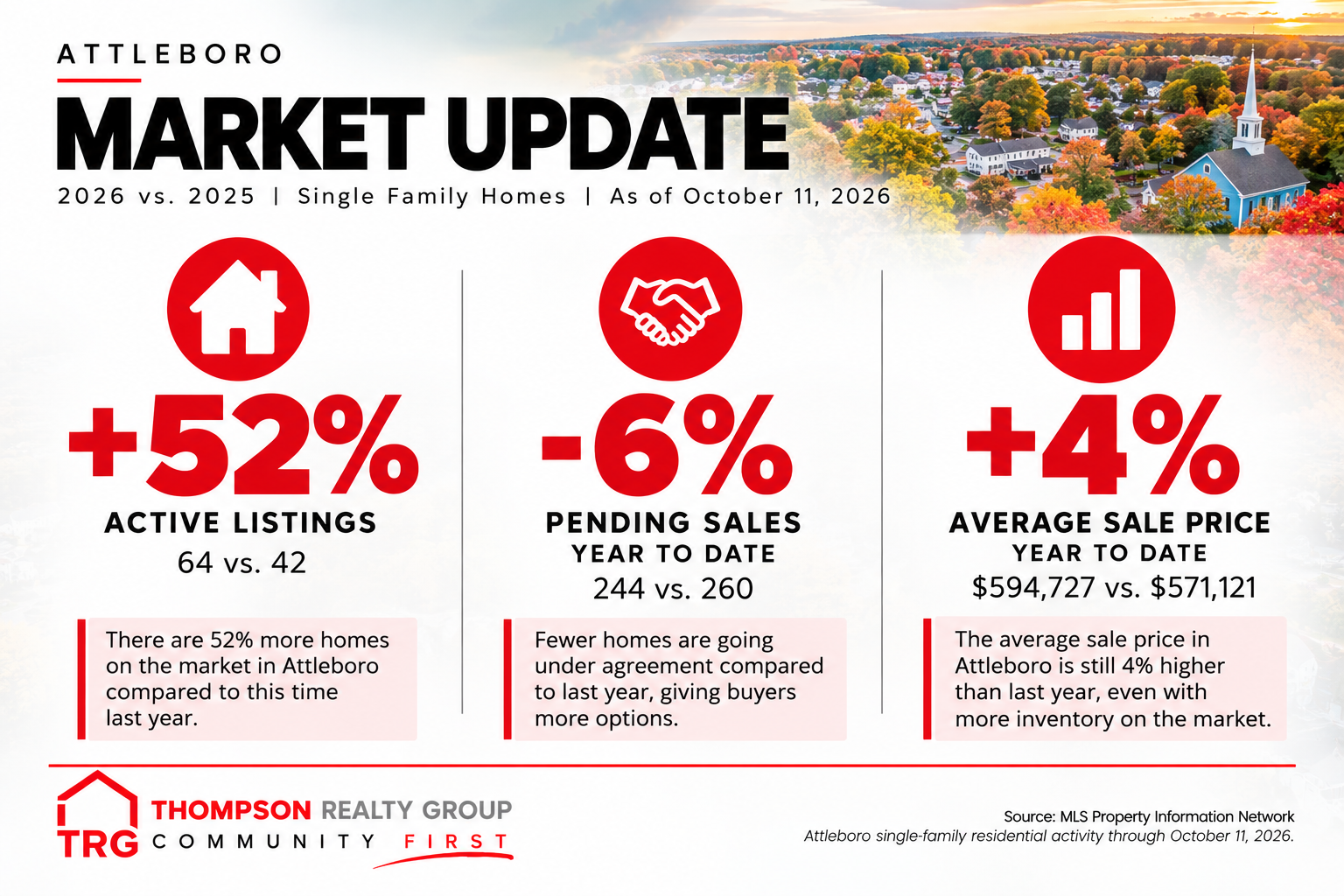
Attleboro Housing Market: October 2026 vs. October 2025
According to MLS PIN, here's how Attleboro's single-family housing market compares with this time last year.
| Market Indicator | 2025 | 2026 | Change |
|---|---|---|---|
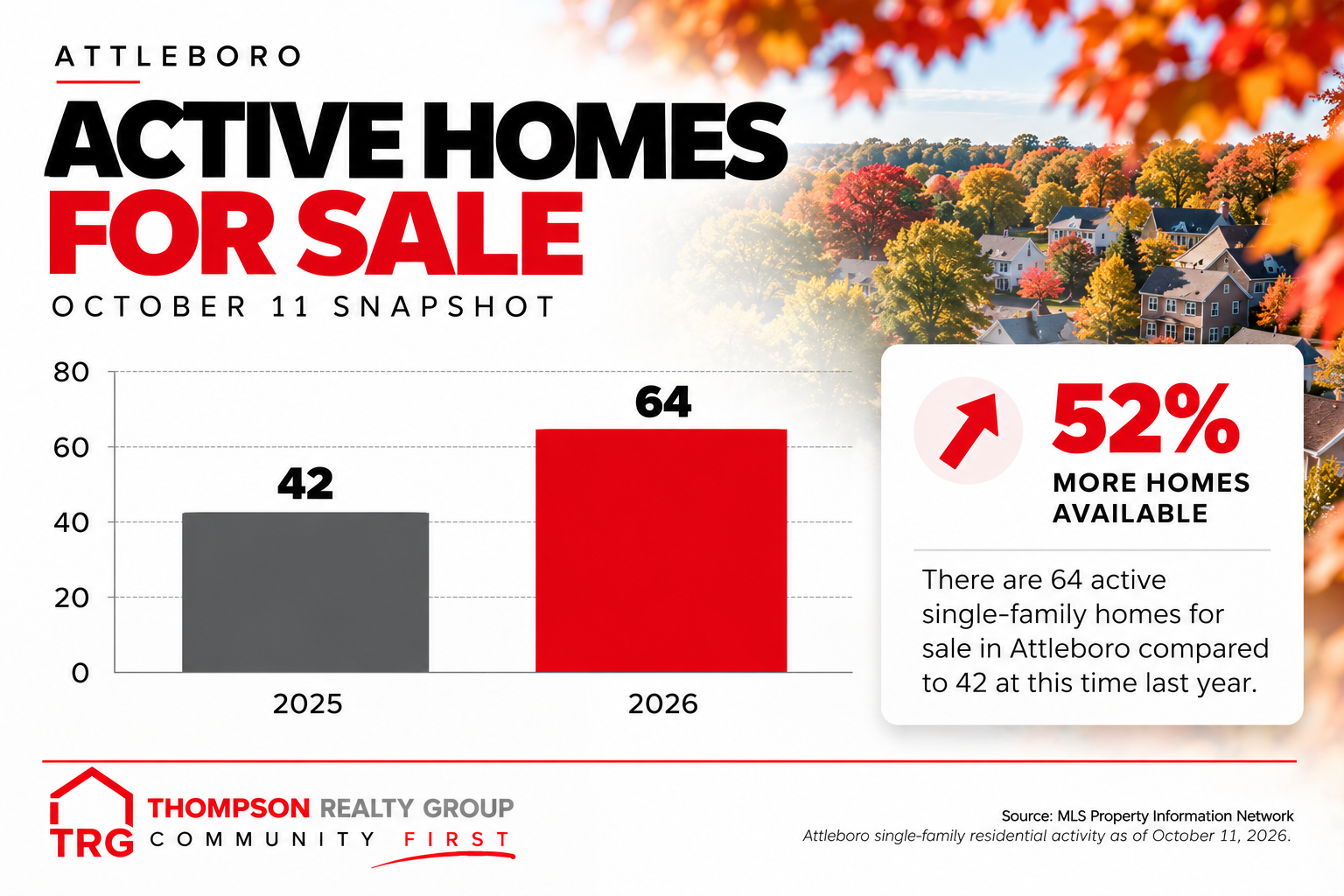
| Homes currently for sale | 42 | 64 | +52.4% |
| Months of inventory | 1.73 | 2.60 | +50.3% |
| Homes sold year to date | 228 | 217 | -4.8% |
| Homes going under agreement YTD | 260 | 244 | -6.2% |
| Average sale price YTD | $571,121 | $594,727 | +4.1% |
| Average days on market for sold homes | 34 | 39 | +14.7% |
| Average sale-to-list price ratio | 102.31% | 101.81% | -0.5 percentage points |
What stands out to me?
We have 52% more homes available than we did a year ago, yet fewer homes are going under agreement.
That's an important shift.
Buyers have more choices, sellers have more competition, and homes are taking longer to sell.
However, with approximately 2.6 months of inventory, we're not suddenly in an overwhelming buyer's market.
And while average sale prices remain higher than last year, that doesn't mean every individual property has increased in value.
The market is becoming more selective, not necessarily collapsing.
Higher Mortgage Rates Are Changing Buyer Behavior
One of the biggest challenges facing today's housing market is affordability.
According to Freddie Mac, the average 30-year fixed mortgage rate was 7.40% as of October 8.
To put that into perspective, on a $400,000 mortgage, the difference between a 6.3% interest rate and a 7.4% rate is approximately $294 more per month in principal and interest.
That's a meaningful difference for many households.
Some buyers are lowering their budgets. Others are taking longer to make decisions. And some have decided to wait altogether.
But for buyers who are financially comfortable purchasing today, there's another side to this story.
Less competition can create opportunities.
Instead of competing against multiple offers, buyers may have more room to negotiate purchase prices, inspection concerns, closing costs, or timelines.
Recently, I helped a buyer negotiate a $20,000 seller credit.
What made that possible wasn't simply asking for money. It was understanding the seller's circumstances and structuring terms that worked for both sides.
That's where experience and communication can make a meaningful difference.
Sellers: The Market Doesn't Care What You Need to Get
This is probably the most important conversation I'm having with sellers right now.
I understand wanting the highest possible price for your home. That's exactly what I want for my clients.
But there's a difference between maximizing your home's value and holding out for a number the market isn't willing to support.
Today's buyers have more options, and many are already stretching their budgets because of higher mortgage rates.
If they discover an inspection issue, they may request a repair or credit.
If the home is overpriced, they may simply move on to another property.
And if a seller refuses to negotiate, that doesn't necessarily mean another buyer will come along willing to pay more.
Sometimes the cost of saying no is greater than the cost of negotiating.
Think about it.
Another 30, 60, or 90 days on the market could mean additional mortgage payments, taxes, insurance, utilities, maintenance, and uncertainty.
It could also mean delaying the purchase of your next home, postponing retirement plans, or missing an important moving deadline.
And eventually, the seller may find themselves accepting less than they could have negotiated earlier.
I'm not suggesting sellers should give their homes away or accept unreasonable demands.
I'm suggesting that a successful sale isn't just about the highest offer. It's about the strongest offer that actually gets you to closing.
Looking Ahead to Q1 2027: Could the Market Slow Further?
As we approach winter, I think it's important to be realistic about what could happen during the first quarter of 2027.
There are several factors worth watching.
1. Mortgage rates may remain elevated
The Mortgage Bankers Association's October outlook anticipates mortgage rates remaining above 7% through 2027.
Forecasts can change, but buyers and sellers shouldn't build their plans around the assumption that rates will suddenly fall dramatically.
If borrowing costs remain elevated, affordability will continue influencing buyer demand.
2. Buyer activity could become more selective
Winter is traditionally a quieter season for real estate in New England.
Combine that seasonal slowdown with higher borrowing costs and more available inventory, and we could see fewer buyers actively competing for homes.
That doesn't mean nobody will be buying.
It means the buyers who are active may be more deliberate about price, condition, and negotiating terms.
3. Sellers may experience more frustration
This is one of my biggest concerns heading into 2027.
Some sellers may continue expecting the same aggressive offers and limited negotiations they experienced during the hottest years of the housing market.
Meanwhile, buyers may feel they finally have enough choices to ask for concessions.
That difference in expectations can create frustration on both sides.
Buyers may feel sellers are being unrealistic. Sellers may feel buyers are asking for too much.
And when neither side is willing to compromise, otherwise workable transactions can fall apart.
4. Home values could become more sensitive to pricing and condition
Will Attleboro home prices increase, decrease, or remain flat in 2027?
Nobody can answer that with certainty today.
National housing forecasts generally point toward modest price growth rather than a widespread collapse. Fannie Mae's Q3 2026 survey of housing experts projected approximately 2.2% national home-price appreciation in 2027.
But national forecasts don't guarantee what will happen in Attleboro.
My concern locally is that if inventory continues increasing while buyer demand weakens, sellers could face greater pressure to adjust their expectations.
That doesn't necessarily mean every home's value will decline.
Well-maintained, properly priced homes in desirable locations may continue performing very well.
Properties with significant condition issues, unrealistic pricing, or substantial competition may face a more difficult road.
I expect pricing strategy and property preparation to matter even more in 2027.
Will 2027 Be a Buyer's Market or a Seller's Market?
I think we're moving toward a more buyer-friendly environment, but I wouldn't declare Attleboro a full buyer's market based on today's numbers.
At 2.6 months of inventory, supply is still relatively limited.
However, buyers are gaining something they haven't consistently enjoyed in recent years: more choices and, in some situations, greater negotiating flexibility.
For sellers, that means the days of putting almost any home on the market at an ambitious price and expecting multiple offers may be less dependable.
And that's not necessarily a bad thing.
A healthier housing market should allow buyers to conduct inspections, evaluate their options, and make informed decisions.
It should also allow sellers to achieve fair market value without unnecessary delays.
The challenge is getting both sides to recognize what today's market actually supports.
My Advice for Buyers and Sellers Heading Into 2027
If you're buying:
Don't assume you need to wait for mortgage rates to fall before exploring your options.
Understand your budget, compare available properties, and consider whether negotiating price or seller concessions could improve your overall purchase.
But don't confuse negotiating leverage with a guarantee of a bargain. The right home still needs to make financial sense.
If you're selling:
Don't base your asking price solely on what a neighbor received six months ago.
Study your current competition. Prepare your property carefully. Price it strategically. And be willing to evaluate reasonable offers based on the complete terms, not just the purchase price.
The objective isn't to win every negotiation.
It's to protect your equity and accomplish the reason you're selling in the first place.
The Bottom Line
Here's how I see the Attleboro market heading toward 2027.
Buyers have more opportunities than they've had in some time, but affordability remains a serious challenge.
Sellers can still achieve excellent results, but unrealistic pricing and unwillingness to negotiate may become increasingly costly.
I don't see enough evidence today to predict a housing crash in Attleboro. But I do see warning signs of a market that's becoming more competitive for sellers.
My biggest concern isn't simply whether home values increase or decrease next year.
It's that some sellers may spend months waiting for a market that no longer exists, only to find themselves making the same concessions later, after losing valuable time.
The goal isn't just to list your home. It's to sell it, protect your equity, and move forward with your plans.
And in a changing market, understanding the numbers — and knowing how to respond to them — can make all the difference.
About the Author
Bill Thompson is the owner and broker of Thompson Realty Group, serving Attleboro, North Attleboro, and surrounding Massachusetts communities. Licensed since 2011, Bill combines local market expertise with a hands-on approach to preparing, positioning, marketing, and selling homes.
Sources & Notes: MLS Property Information Network, Attleboro single-family market review as of October 11, 2026; Freddie Mac Primary Mortgage Market Survey; Mortgage Bankers Association mortgage forecast; Fannie Mae Q3 2026 Home Price Expectations Survey. Local statistics compare equivalent reporting periods. Mortgage payment examples exclude taxes and insurance. Forecasts are estimates, not guarantees.

Bill Thompson
Managing Director | Broker | Bill Thompson | Keller Williams Elite
or another way